I'm in my later 40's and I've rubbed elbows with all sorts of people in my day. The poorest our country has to offer, the wealthiest you could deign to find, and everything in between. I've have multiple hobbies and interests, and as a fairly out-going social person, I tend to seek out people who share my hobbies and interests. The best of course is face-to-face associations and friendships, but in this day and age, the option to interact with others as a distance has never been easier or more available.
All this is to say, I am entirely impressed by the polite and gentle behavior of the snuff-takers I have interacted with thus far. The snuff-takers I've met face-to-face are always happy to have met a fellow traveler, and are quick to jump into conversation and to offer a pinch of their favorite snuff. Meeting a snuff-taking stranger, is like meeting a long-lost friend with all the attendant joy and need to catch up.
Online, snuff-takers are welcoming, humble, quick with advice, slow to deride or pass judgement, and show a calmness in their interactions that only confidence and a pinch of snuff could lend a person. Snuff is talked about, traded, gifted, and held aloft as an unbreakable common bond. Jaded by my interactions with the average person online, I find myself thinking it is too good to be true at times. I find myself bracing myself for the next attack. Watching for the knife stuck deftly into the shoulder-blade, as a well-practiced internet-warrior makes a cowardly attack from behind. But, the attack never comes...the blade is never bared.
If you have found yourself drawn to nasal snuff, and you are curious, or need advice, or simply want to interact with other snuff-takers, reach out. You will never find a more welcoming group of people. Feel free to join both of the groups below, and thus enrich your own enjoyment of snuff-taking. You will certainly find some fine acquaintances, and maybe a friend or two in the process.
Mark Stinson
Modern Snuff Website
Friday, November 6, 2015
Thursday, November 5, 2015
Redheart Double-Bowl Snuff Spoon - Hand Carved
This is a double-bowl snuff spoon, designed to allow a bowl-full of snuff to go up both nostrils at once. I carved the spoon from beautiful redheart wood and this is its natural color and finish. This spoon was given a long and graceful handle to make it easier to use and maneuver. Double-bowl snuff spoons were very common among the snuff-taking Zulu tribes. The double-bowl on this spoon can be loaded from the smallest tin, smash-box, or snuff box. If you are interested in this spoon or others, visit My Shop. Click on any of the images to see a larger version.
Mark Stinson
The Marie Antoinette Most of Us Don't Know
In the 18th century giving a snuff box as a present became a sign of exalted gift-giving. Marie Antoinette had fifty-two gold snuff boxes in her wedding basket. While this may seem extravagant, it should be remembered that in the eighteenth century the snuff box was the equivalent of jewellery and not only did the snuff box change with artistic fashion but anyone who was anyone needed to have a variety of these boxes.
What most people think they know about Marie Antoinette is actually false. She was originally Austrian. She never actually said, “Let them eat cake.” She was a champion of the American
side of the Revolutionary War, and without her efforts the war might have ended quite differently. After the French Revolution, none other than the American revolutionary Thomas Paine (at that time part of the French Legistlature, as strange as that sounds) advocated exile for the Royal Family to the United States, rather than death. Marie Antoinette was a loving dedicated mother, and she faced execution by guillotine bravely. Marie Antoinette also took snuff, though it is said she was more likely to carry a box of bon bons on her person, than a snuff box.
She may have also standarized the modern handkerchief as we think of it today. The handkerchief has a long history as a piece of cloth carried to clean one's nose. But, prior to the triumphant arrival of tobacco (specifically snuff tobacco) in Europe, the handkerchief had become an object of fashion. Snuff brought the handkerchief back to its original purpose, as it became indispensable for cleaning snuff-stained noses! White handkerchiefs were hardly suitable for this and people took to using large, coloured kerchiefs to hide the stains. Up until this time, the handkerchief had come in many shapes, such as round, square, triangular, etc. According to legend, one day Marie Antoinette at Versailles remarked that the square-shaped handkerchief was the most pleasing as well as convenient. This prompted Louis XVI to make it mandatory for all handkerchiefs produced within the kingdom to be square in shape. And the rest, as they say, is history...
Click Here to read about more famous snuff-takers.
Mark Stinson
Modern Snuff Website
Wednesday, November 4, 2015
Snuff Feeds Your Senses
![]() |
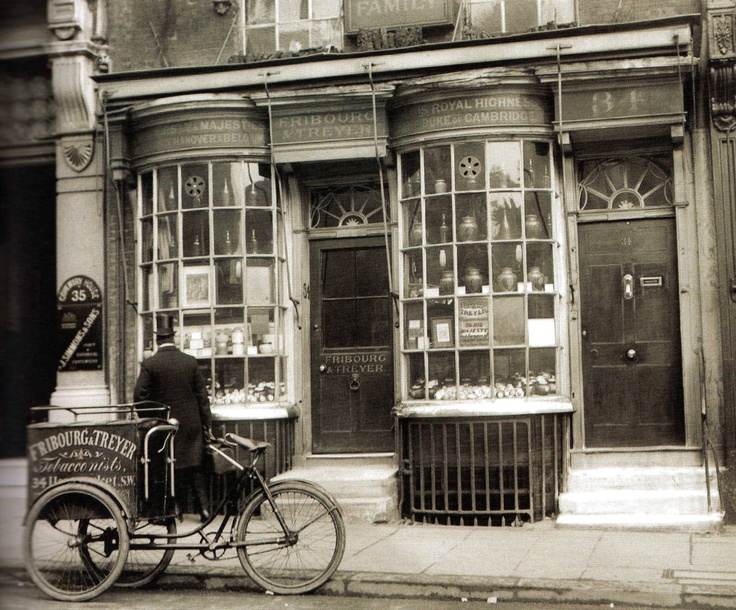
| Fribourg & Treyer in 1906 |
Snuff is to the nose what our favorite song is to our ears. Snuff directly interacts with our olfactory senses, which have been shown to have a strong connection with our memories. First there is the ritual. A tap on your tin or box. The pinch warming between your fingers. The snuff settling into the front of your nose. And the slight pleasant burn of the tobacco accompanied by the full and complete scent that fills you entire nose, Over time, as the scent lingers, it changes...and layers of flavor are revealed.
The right snuff can take us to places and moments in our life, and have an impact on our present. Sometimes this is very overt and obvious, and we can identify the memories that are consciously triggered. But, most of the time it is more subtle than that, and the complex layers of scent and sensation change us in the moment. The right snuff sparks an emotional reaction, and can shift our demeanor dramatically.
Yes, snuff delivers nicotine from the tobacco into our bodies. But snuff-taking is so much more than a chemical reaction. Snuff takes over one of our five senses, and drags us along for the ride. That act of taking snuff is a stolen moment from the rest of the world, and the flood of sensation and scent that hits us sets the stage for a definitive shift from where we are, to where we want to be...
Mark Stinson
Modern Snuff Website
Tuesday, November 3, 2015
What's the Purpose? Nicotine or Enjoyment?
![]() |
| Offering a Pinch |
I'm not sure the two sides of this debate are as juxtaposed as they appear at first. I mean, I can understand both of those view-points. I think I've probably been at both ends of the scale, depending on when in my life we're talking about. There have been points in my life where I've used tobacco products I didn't even like that much, just to get the Nicotine. There have been other points in my life where I used a tobacco product purely for the taste (mainly with cigars).
But, now I'm somewhere in the middle. I do very purposefully "maintain" my nicotine levels. It calms me, focuses me, and makes the world make sense for me. It just levels me out, and brings me a feeling of peace. So, yes...I do put some thought into maintaining my Nicotine levels, and thus maintaining the feeling it gives me. I'm addicted to Nicotine. If I went cold-turkey from all Nicotine tomorrow, I would be a raving mess for 3 or 4 days, and be thinking about Nicotine for months afterward. I know, because I've been there.
But, now I only use tobacco products I truly enjoy. Ones that have benefits and joys far beyond the delivery of Nicotine. Ones that make me happy on their own. I would take snuff, even if snuff had no Nicotine...because I like the sensation, the scent, and flavor. Hell, I even like a good back-drip with the right snuff. So, I get that. But, it sure is nice it also helps me maintain my Nicotine levels. One of the benefits of snuff, is it works on both levels. Nicotine and Enjoyment.
Anyhow, its interesting hearing where people describe themselves on that Nicotine vs. Pure Enjoyment scale. I think I'm somewhere in the middle. Where are you? Feel free to comment below.
Mark Stinson
Modern Snuff Website
Thursday, October 29, 2015
1967 Video - Snuff Month in Oxford
The history of snuff-taking is interesting, and its fun when you stumble across some old film of snuff-takers. This particular piece is from 1967 and was shot at Oxford, where the Society of Snuff Grinders, Blenders, and Purveyors sponsored a month of snuff sniffing sessions for experienced snuff-takers and newcomers as well.
I love the 1960's sound and feel of this video, and you get to see a couple of cool snuff boxes and plenty of snuff pinching. This video is belongs to British Pathé, a producer of newsreels, cinemagazines, and documentaries from 1910 until 1970 in the United Kingdom.
Mark Stinson
Modern Snuff Website
Snuff Puts Money Back in Your Pocket
It is interesting to note the ways that snuff brings happiness.
Despite the common saying that "money does not buy happiness," it has been my experience and observation that "a lack of money definitely brings unhappiness." It is difficult to deny that being able to pay one's bills makes one happy. Or that being able to buy food and entertainment in its various forms can certainly make one happy. Money pays for your children's clothes, their after-school activities, books, tablets, doctor's appointments, orthodontics, and stability and security. How would money not naturally lead to a better chance at happiness. In a commercialized world where money equals comfort and freedom in our capitalist culture, that old clunker of a common saying about money may be missing the point a little.
Let's get to the point. Snuff is cheap. Really, snuff is dirt cheap when compared to other tobacco products. Even for the biggest snuffy sniffer, a little ground tobacco goes a long way. I currently have about $80 invested in snuff. Maybe as much as a $100. I have enough snuff to last me literally 2 to 3 years of constant snuffing, even factoring in the gradual increase in consumption I'm going to experience over the next 2 to 3 years. Even "expensive" snuff goes a long way for very little money. There are only so many little pinches you can fit up your nose in a day, and there are a lot of pinches in a tin of snuff.
Don't get me wrong. It is tempting, and it would be easy enough, to spend hundreds of dollars on nasal snuff in an attempt to try all the various kinds of snuff you are curious about. It would be easy indeed to drop some serious cash on a proper snuff collection with brands and flavors from all over the world. But, in a true comparison of cents per use, dollars per dose, snuff is immensely reasonable in price. Someone switching from cigarettes to snuff would save piles of money in a very short amount of time. Someone choosing snuff and vaping, would be money ahead making snuff their habit of choice. Chew, dip, and snus are more expensive than snuff as well.
So, enjoy yourself frugal snuff-taker! Cherish the $3 tin of snuff that you are still pinching out of a month later. Delight in the $5 tin of snuff that begins to prove itself nearly bottomless as part of your snuff rotation. Count your blessings and your pennies, as your snuff habit puts money back in your pocket.
Mark Stinson
Modern Snuff Website
Wednesday, October 28, 2015
Hand-Carved Snuff Spoons for Sale
I've set up an shop to sell some of the hand-carved snuff spoons I've been carving. I tend to use exotic woods, and each snuff spoon is unique and special.
Click Here to visit the shop.
Mark Stinson
Modern Snuff Website
Tuesday, October 27, 2015
Why Some Snuff Boxes are Shaped like Women's Shoes...
If you google vintage or antique snuff boxes, you find quite a few of them that are shaped like women's shoes. And so this begs the question, why did the Victorians use shoe-shaped snuff boxes? For those of us living in modern times, it seems like an odd choice.
When I decided to dig into this question, I was amazed at the number of different theories there were, and how diverse they were. Here are a couple of theories that you will hear from time to time, that I believe to be incorrect.
1. That because most of them are shaped like women's shoes, the snuff boxes must have all belonged to women, because "women seem to like shoes." This as we will see below, is incorrect. In actuality, men owned these shoe-shaped snuff boxes, and they were not relegated to women.
2. One source suggests that the shoe is a symbol in Freemansonry, and that many shoe-shaped snuff-boxes are decorated with masonic symbols. While some of these snuff boxes do have masonic symbols on them, most of them do not. Freemasons decorate all sorts of things with their symbolism, so of course some of them decorated their snuff boxes in this way. While the shoe is a symbol in Freemasonry, shoe-shaped snuff boxes did not originate with the Freemasons.
3. The same source from #2, also suggested that in the Bible the shoe symbolizes the earthy in contrast with the holy, and thus the shoe-shaped snuff box was a reminder that snuff taking was an earthly vice. There is no reference to this in any other source that I could find, and as we'll see below the shoe symbolizes many more things than the "earthly."
4. Its been suggested that Victorians were a little obsessed with catching a glimpse of a woman's shoe and ankle, and therefore identified a woman's shoe with something a bit naughty or illicit. And thus, what better shape for a man to offer another man a pinch form, than a somewhat illicit woman's shoe. While this is true, there is more to it than that.
So, let's build on this last one and give as complete an answer as is possible.
The shoe is symbolic of good-luck, it has romantic connotations, and specific it has symbolic connections with weddings and travel. So in the 18th and 19th centuries, a shoe-shaped snuff box was often given as wedding gift or as a gift to a traveler to bring them good luck. There was a novelty aspect to making many different Victorian objects in the shape of a shoe, and the snuff-box was just one of these objects. If you enjoy history, then you may enjoy some additional information.
Shoes are more than just a depiction of footwear here. The shoe is a romantic symbol that has been with us a long time. In the middle ages, a father would hand the bridegroom a shoe to transfer the authority he had over his daughter to her husband. Today, we tie shoes to the bumper of the honeymoon car. Shoes and Eros are soul mates: Fetishists adore shoes as symbols of the female sex. In the Victorian age, the peek of a shoe from under the all encompassing, many layered skirts could arouse a passionate interest. Cinderella loses her shoe and it leads the prince to her, the 12 Princesses dance holes in their shoes and finally, there's Puss in Boots!And some additional information from another source:
Shoe- shaped snuff boxes were commonly made throughout the 18th and 19th centuries. Traditionally associated with good luck wishes, they were given as gifts for travelers and wedding couples setting off on the "journey" of marriage. (Source)
Shoe and boot shaped snuff boxes were made throughout the 18th and 19th centuries. Shoes have long been associated with love and marriage and were often given for good luck. (Source)A tradition of giving a shoe-shaped snuff box as a gift at a wedding or to a traveler would explain why we see so many examples of shoe-shaped snuff boxes. This tradition is in line with the romantic nature of shoes, especially for the Victorians.
Miniature Shoes," Zita Thornton has this to say:
Modern, ornamental shoes made from porcelain or resin, have become a collectable favourite in the last few years. However, a fascination with miniature shoes goes back thousands of years. Miniature sandals have been found in Egyptian tombs and fashioned from ancient Persian pottery.
When shoemaking became a highly skilled, decorative craft in the seventeenth century, shoe makers expressed their skill in miniature too. Until the nineteenth century, miniature shoes, as exquisite in their detail as their full sized counterparts, became tokens of prosperity and love and symbolised a desire to share worldly goods, hence the tradition of hanging boots on the back of a newly wed's car.
The emergence of porcelain brought the fashion to aristocratic circles when elegant but expensive porcelain or enamel versions were exchanged. In the nineteenth century the love of novelty encouraged the manufacture of miniature shoes in a wider variety of materials such as leather, wood and brass and brought the custom within the reach of sentimental Victorians of all classes. The less sentimental looked for a function in their ornamental shoes and in this they were continuing a tradition that had its roots in ancient times. The Romans had oil lamps shaped as a foot in a sandal, and perfume containers as hob nailed boots. An ancient ancestor of the stirrup cup was a drinking vessel called a rhyton, which was sometimes made in a boot shape. Victorian gentlemen had shoes fashioned as gin flasks, umbrella handles, paper knives and ink wells, as well as all the paraphernalia associated with smoking and snuff taking such as snuff boxes, match holders, tobacco jars, ashtrays and pipe stops.The snuff box on the right is an interesting example. And the following information is from the webpage from which I borrowed the image for this discussion.
This snuff box was owned by the artist Talbot Hughes (1869-1942), who had a large collection of historic dress and accessories. The London department store Harrod's bought the collection and gave it to the Museum in 1913 after displaying it in the store for three weeks.
Shoe-shaped snuff boxes were made throughout the 18th and 19th centuries, probably as gifts. This boot, with its squared toe, is in the fashion of the 1860s. Shoes were traditionally associated with good luck wishes for travellers and wedding couples setting off on the 'journey' of marriage. Silver-coloured shoes are still sometimes used at weddings as good luck tokens.So, that is definitely my longest blog post thus far. I've been intrigued with the shoe-shaped snuff boxes since the first time I saw a picture of one. They seem odd at first look, but with a little consideration of their symbolism and historical meaning, they tell an interesting story from the history of snuff-taking.
To see a photo album with lots of shoe-shaped snuff boxes, Click Here.
Hitsuzen Reviews Bernards Doppelt-Fermentiert
This is Hitsuzen's review of Bernards Doppelt-Fermentiert, which is part two of a four part series on Schmalzlers. Check it out...and if you haven't subscribed to his channel yet, hit that subscribe button!
Mark Stinson
Modern Snuff Website
Mark Stinson
Modern Snuff Website
Subscribe to:
Posts (Atom)